
K-pop world tours 2026–2027: every announced date and how to follow along
Published 2026-10-10 · 7 min read
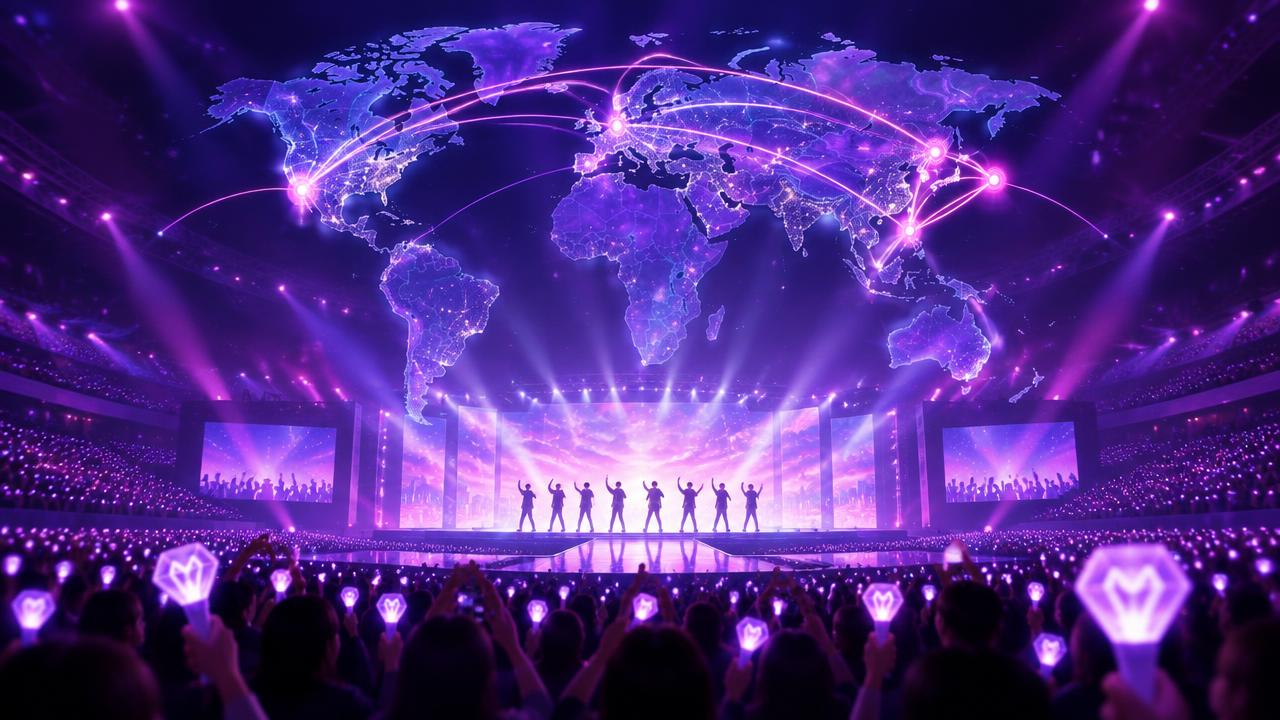
The 2026–2027 touring cycle is the biggest K-pop has ever had. BTS are back on the road with ARIRANG, Stray Kids are running stadiums with RUN IT, and aespa, ENHYPEN, LE SSERAFIM, BABYMONSTER, NCT 127, XG, ITZY and TOMORROW X TOGETHER all have multi-continent schedules. Our [concerts calendar](/concerts) tracks every announced date with sources.
But a world tour creates two language problems, not one. If you travel to a show, the venue announcements, signage and the idols' ment (talking segments) are in Korean or the local language. If you stay home, the livestreamed shows, fan-captured clips and next-day Variety content are in Korean too. This guide covers both.
The big tours at a glance
Dates below are the announced legs as of October 2026 — always confirm with the promoter before booking travel, and check the [full calendar](/concerts) for venue-level detail.
- BTS — ARIRANG: Asia through late 2026, North America and Europe in 2027.
- Stray Kids — RUN IT: Asia and Oceania legs, including Taipei Dome in December 2026.
- aespa — SYNK: Asia and North America arenas.
- ENHYPEN — WALK THE LINE: Asia, North America and Europe.
- LE SSERAFIM — PUREFLOW: Asia including Taipei in November 2026.
- BABYMONSTER — CHOOM: Asia arenas through early 2027.
- NCT 127 — THE REDLINE: Asia into January 2027.
- XG — THE CORE: Asia and Oceania, Taipei Arena in October 2026.
- ITZY and TOMORROW X TOGETHER: Asia and North America legs.
At the venue: what you'll actually need translated
Korean concerts are famously organized — and famously monolingual. The safety announcements, the queue system, the merchandise booth, the fan-project instructions printed on your seat: nearly all of it is Korean-first, even at overseas stops where the staff switch to the local language.
Echo's Around Me mode listens to the room and captions what the PA system is saying. Screen mode reads the signage and the fan-project card you were handed at the door. Both run on your iPhone with the floating overlay, so you can keep the captions on top of your camera while you film.
The ment is the best part — and the least translated
Between songs, idols talk. These talking segments — the ment — are where the inside jokes, the crying, the anniversary speeches and the tour announcements happen. They are also entirely unscripted Korean, which means the official subtitles (when they exist at all) arrive days later with the VOD.
Audio mode captions the ment live from your seat. Because Echo carries a K-pop glossary of around 770 terms, member names and fandom names survive translation instead of dissolving into random nouns.
Following from home
Most major tours now livestream at least one stop — usually a Seoul or Tokyo date — through Weverse or a paid streaming partner. The stream is Korean audio with, at best, delayed subtitles in a few languages.
Run Echo in Audio mode alongside the stream and the captions keep up in real time. Echo's free tier covers 5 minutes a day, which is enough for a highlight; a full concert is a Day Pass (90 minutes, one-time) or Echo Plus Weekly, which starts with a 3-day free trial.
A realistic concert-day setup
- 1
Download and set languages before you leave
Set Korean as the source and English, 简体中文 or 繁體中文 as the target while you still have good Wi-Fi.
- 2
At the venue, use Around Me mode
Captions the PA announcements and the ment from your seat.
- 3
Use Screen mode for signage and fan projects
Point it at the seat card or the merch menu and read it in your language.
- 4
At home, pair Audio mode with the livestream
The floating overlay keeps captions visible over the video.
Answers, before you ask.
Are these tour dates confirmed?
Every date on our concerts calendar links to the official announcement or promoter page. Rumored tours are excluded until officially announced.
Does Echo work in a loud arena?
Around Me mode is designed for exactly this — it picks up the PA and stage audio from your seat. Very loud sections (during songs) are music, not speech, so captions focus on the talking segments.
Can I use Echo for a Japanese or Chinese stop?
Yes. Echo translates between Korean, Japanese, Chinese (Simplified and Traditional) and English, so overseas stops in Japan, Taiwan, Hong Kong and Macau are covered too.